
2026-09-10
Most of us never go near a Court of Law. We have lives to live, families to nurture, careers to progress, recreations to restore our physical mental and spiritual health, and life balance.
"Prudence, indeed, will dictate that Governments long established should not be changed for light and transient causes; and accordingly all experience hath shewn, that mankind are more disposed to suffer, while evils are sufferable, than to right themselves by abolishing the forms to which they are accustomed"
So we put up with the demands of the State until they become intolerable, for whatever reason. We have better things to do than fight an unequal battle against a bureaucratic system that can call on more resources to fight us than we can to fight it.
And yet ...
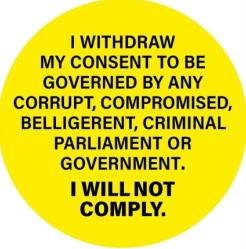
"But when a long train of abuses and usurpations, pursuing invariably the same Object evinces a design to reduce them under absolute Despotism, it is their right, it is their duty, to throw off such Government, and to provide new Guards for their future security."
It's hard to think of a greater abuse, or a bigger usurpation of powers, than those inflicted upon the world by the Covid scam, the Climate Change scam, and not least the Government-Corporate scam whereby medical tyranny is enforced by government-supported cartels, paid for by taxation, and medical responsibility is abrogated by forbidding the normal legal claims of damage to health from medical drugs products and protocols.
If now isn't the time for change, then it never will be.
Yet, assuming that such a change may be upon us at some point "soon", what system of governance should replace the existing arrangements?
Whilst I claim neither authority nor wisdom to make such a far-reaching proposal, this site has given space to some of the principle ideas that might point a way forward:
- Removal of control by political parties (who can be bought or otherwise illegally controlled)
- Return to Magna Carta principles whereby no man may be punished except by the judgement of his peers, and whereby unacceptable laws may be struck down by a jury's verdict
- Return to Common Law, abolish the incomprehensibly large Statute Book and start again (OK, we are talking principle here. If "Ignorance of the Law is no Excuse" then so too must the Law be comprehensible accessible and simple enough for the "Standard Citizen" to be taught as part of their education in citizenship)
- Just as corporations have their accounts audited, so must Government activities be audited to ensure compliance with the Law
- Government complexity must be stripped out, QUANGOs and 'regulators' and other arms-length quasi-governmental bodies abolished so that the operation of government can be transparent and understandable by the 'Standard Citizen'
- Nothing that can be satisfactorily governed by local government should be controlled at any higher level (and yes, the 'standard citizen' is the lowest level of 'local government'!)
Quite aside from the above principles, Martin Geddes has some pertinent ideas of his own concerning how the relationship between Government and the Standard Citizen might be ... facilitated.